
How to Write a Federal Resume
The format HR scores you on, a complete example resume you can copy line for line, and the three AI prompts I use to write a job entry and then tailor it to any announcement.
The federal resume format is short to state and easy to get wrong, and the wrong version is what ends most applications before a person reads them.
This page fills the format in. You get every field USAJOBS requires on an entry. You get a full example resume, laid out the way HR expects to read it. And you get the three AI prompts that write an entry for you, then fit it to any posting.
The short answer
A federal resume is two pages, and you build it inside the USAJOBS resume builder instead of uploading your own file. Every job on it gets the same shape. One short paragraph of three to five sentences, then four to six bullets with numbers in them. The one job you are using to qualify has to show the posting's Specialized Experience in your own words, never copied. That is the whole format.
Why the format is what screens you out
Federal hiring runs a paper check first. When a posting closes, HR reads every application to see who is eligible and who meets the minimum. On a lot of jobs your resume then goes to a subject matter expert. That person checks one thing: the Specialized Experience the posting lists. On the rest, HR makes that call. Either way, you never talk to the reader. You get scored on paper.
Then people get sorted into piles. Best Qualified, Well Qualified, Qualified. Only the Best Qualified pile usually gets referred. That is three to ten names, and it is the only list the hiring manager sees. Everyone else gets an email. If you have had one, the reasons a federal application comes back "not referred" are almost all format and paperwork, not talent.
So the format is not cosmetic here. It is the thing being scored.
Why a private-sector resume gets you rejected
Federal resumes have to include what private-sector resumes leave out. For every position you list, USAJOBS requires four things:
- Employer name.
- Job title.
- Start and end month and year.
- Hours per week.
Miss one and you can be cut. One job entry with no hours per week does it. Salary and supervisor contact are optional, and I put both in anyway.
The resume builder asks you for every field, so nothing goes missing. It also puts out the format HR's systems read cleanly. That is why you build the resume inside USAJOBS instead of uploading your own file. However sharp yours looks on screen. You can save five resumes in your profile, and you can copy one and edit it for a different job.
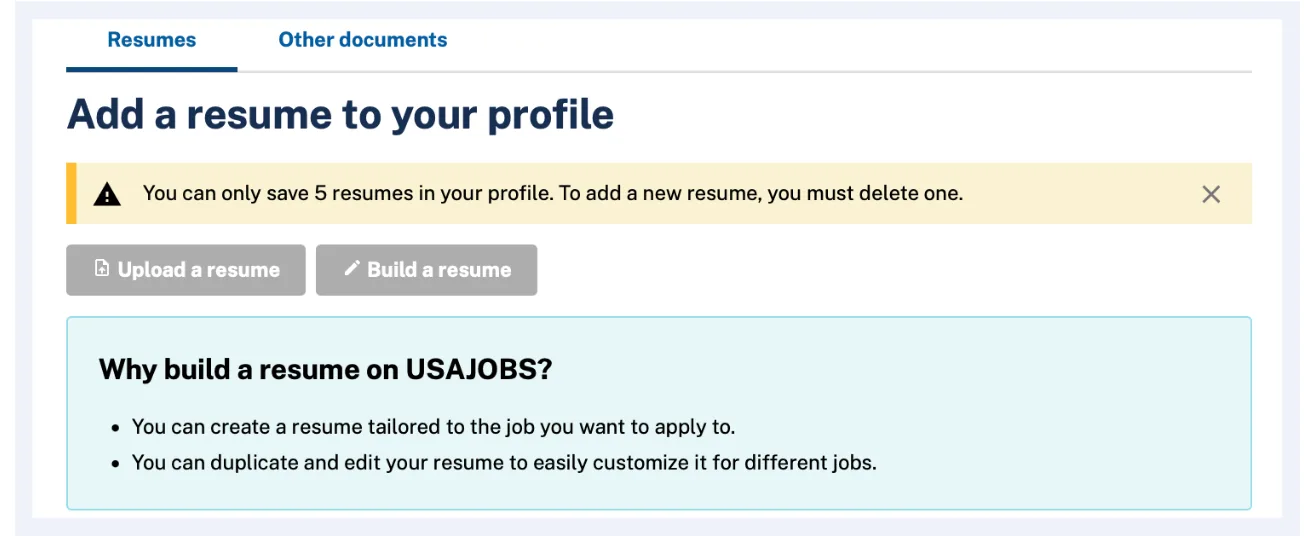
Two details HR checks first: every entry needs hours per week. HR counts your experience by the hours you worked, and a part-time job earns part credit. Exact month and year dates are the other one. They prove you have been doing the work long enough.
The two-page limit
Federal resumes used to run ten to twenty pages. Mine was ten. As of September 27, 2025, resumes are capped at two pages for most jobs. USAJOBS will not let you submit a longer one.
Two pages does not mean vague. HR cannot fill in a blank for you. If the posting asks for a skill, name it in plain words. What changes is where the lines go. Put your most recent and closest work first. Keep school, certs, and extras short. Skip the references section, because reviewers call your supervisors anyway. Give your last five to ten years the space, since that is what gets read.
Bottom line: two tight pages that mirror the announcement beat ten pages of everything you've ever done.
The format that works
Every position entry on your resume follows this structure.
1 · One short paragraph
Three to five sentences describing the role and your overall responsibilities.
2 · Four to six bullets
Accomplishment-based, each one showing measurable impact. Quantify everything you can. Numbers turn duties into proof: supported 200 users, cut ticket backlog 40%.
That's it. That's the format. Repeat the same structure for every job entry on the resume: same paragraph, same bullets.
Then mirror the posting. The entry you are using to qualify should show its Specialized Experience in your own words, never copied word for word. Copying their sentences gets you cut. Tailor that one entry only. The other jobs stay as they are, so tailoring is a ten-minute job instead of a rewrite every time you apply.
Write to the grade, too. The series and grade sit at the top of every posting. "0343-09" is the Management and Program Analysis series at GS-9, and your experience has to read at that level.
Read the Duties section before you decide what to mirror. Federal job titles are broad on purpose. An "IT Specialist" posting can be a help desk seat or a program manager job. The duties tell you which one you are looking at.
The USAJOBS Playbook, Free
✓The federal resume format that gets past HR review
✓Every hiring authority you qualify for, including two that skip USAJOBS
✓How your application is scored, and the questionnaire rule that cuts most people
Where should we send it? It's free.
A federal resume example in the format HR expects
Here is a complete federal resume in that format. The applicant is made up. The structure is the one I would hand you. Read the shape first, then the words.
William Brown
Phone: 555-555-0155 Email: test@example.com
Relevant Work Experience
IT Project Manager | Workday Inc. | Washington, DC 08/2024 - Present · Hours per week: 40
Served as IT Project Manager within a corporate technology organization supporting enterprise systems, infrastructure, and business applications across multiple locations. Led technology initiatives from planning through implementation, coordinating technical teams and business stakeholders.
- Managed 12+ concurrent technology projects with budgets up to $1.5M by developing project plans, defining scope, tracking milestones, and coordinating resources, delivering 95% on schedule.
- Led cross-functional teams of up to 15 developers, systems administrators, business analysts, and support personnel, facilitating project meetings and resolving issues.
- Coordinated system implementations, software upgrades, and infrastructure modernization efforts, overseeing testing activities, deployment planning, user readiness, and post-implementation support.
- Partnered with business stakeholders to gather requirements, document project objectives, evaluate solution options, and develop implementation strategies that addressed organizational needs and supported long-term technology goals.
Systems Engineer | RTX Corporation | Atlanta, GA 07/2020 - 08/2024 · Hours per week: 40
Served as Systems Engineer within a technology services organization supporting enterprise business systems and operational processes across multiple departments. Worked closely with business stakeholders, technical teams, and vendors to improve system performance, support organizational initiatives, and ensure technology solutions aligned with operational needs.
- Analyzed system performance and operational processes to identify improvement opportunities and recommend solutions, reducing recurring incidents by 30% and improving overall service reliability.
- Collaborated with cross-functional teams to troubleshoot operational issues, resolve system-related challenges across 30+ enterprise servers, and support ongoing maintenance that held uptime above 99.5%.
- Assisted with system testing, deployment planning, user training, and change management activities to ensure successful adoption of new technologies, processes, and business solutions.
- Developed and maintained documentation, process guides, and operational procedures while providing support and guidance to users and stakeholders to promote effective utilization of organizational systems and resources.
Helpdesk Support Specialist | Worldwide IT Services | Falls Church, VA 07/2019 - 07/2020 · Hours per week: 40
Served as Helpdesk Support Specialist within a regional technology services organization supporting employees and customers across multiple office locations. Provided frontline technical support while six independently managed support teams were consolidated into a single service desk, helping keep service consistent for users throughout the transition.
- Provided Tier 1 and Tier 2 technical support for 500+ users, resolving 80% of tickets on first contact, documenting incidents, tracking service requests, and escalating complex problems to senior technical teams while maintaining established service level objectives.
- Assisted users through phone, email, chat, and ticketing systems, closing an average of 40 tickets per week, and providing guidance on technology tools, policies, and procedures to ensure efficient issue resolution.
- Supported the consolidation of six regional support teams into a centralized helpdesk by documenting existing service procedures, identifying gaps in coverage, and helping standardize how routine requests were handled.
- Assisted with onboarding and transition activities as users and processes moved into the centralized service model, delivering user training, answering questions during cutover, and sharing knowledge with incoming support staff.
Education, Certifications, and Licenses
Bluefield State University | Bluefield, WV
Associate's degree | GPA: 3.1 of a maximum of 4.0 | Credits Earned: 60
Additional Information
- ITIL Foundation v4 Certification
- CompTIA Security+ CE Certification, DoD 8570/8140 IAM I/IAT II
- Project Management Professional Certification, PMP
What to notice.
- The top line of every entry carries the job title, the employer, and the city and state. Then the month and year dates, and hours per week. All five, every time.
- Each paragraph sets up the job in three to five sentences. It says what the role was and what it covered. It does not try to prove anything yet.
- Every bullet carries a number: 12 projects, $1.5M in budget, 95% on schedule, 15 people, 30% fewer incidents, 30+ servers, 99.5% uptime, 500+ users, 80% first-contact resolution, 40 tickets a week, six teams merged into one. Count them on the page.
- School and certs take up four lines between them, and there is no references section.
- The help desk entry is the one to study. It is the same job most people write as "answered phones," and here it fills a third of the resume. If that is where you are starting from, read how to get a federal job with no experience next.
Using AI to write it and tailor it
Use AI such as ChatGPT or Claude to write a clean resume. Then fit it to every posting. Paste in what you actually did, however rough. Fragments, bad grammar, a list you typed on your phone: none of that matters, because the prompt does the shaping. What AI cannot do is invent the work, so give it the real duties and the real numbers.
Copy these three prompts into an AI platform of your choice.
"Here is a job from my work history: [paste your job duties, however rough]. More context on my background: [paste anything relevant]. Rewrite it as a federal resume entry: one sophisticated, accomplishment-driven paragraph of 3 to 5 sentences, then 4 to 6 bullets. Keep the substance of the real role accurate. Sharpen the language."
"Here is the resume entry for the job I'm using to qualify: [paste your resume entry]. Here is the Specialized Experience section from the announcement: [paste the announcement's Specialized Experience]. Rewrite my entry so it shows how my real work history demonstrates that required experience. Do not copy the announcement's language verbatim. That is disqualifying. Output a revised paragraph plus 4 to 6 bullets."
Run prompt 2 on the entry you are using to qualify. On that entry only. Every other job on the resume stays where it is.
"Reframe this into professional, federal-appropriate language, keeping every fact accurate: [paste your bullet or duty]."
Before: "Managed point-of-sale system and closed cash register nightly."
After: "Operated and reconciled the point-of-sale system, closing out daily receipts and resolving discrepancies to ensure accurate end-of-day financial reporting."
Same job, same facts, same nightly close. One version reads at the grade you want. The other one does not.
Employer names and job titles. Always use the employer's official company name. That is the business that paid you. Not the store, branch, or franchise number. You can clean up your job title the same way. The name has to really be that employer's. The title has to really describe the work you did. AI can help with both.
- Walmart Supercenter #485 → Walmart Inc.
- TitleMax → TMX Finance
- Bug Out Pest Control → Terminix North America
- Assistant Store Manager → Assistant Manager
- Grocery Department Lead → Department Lead
- Helpdesk Specialist → Information Technology Specialist
My own job carries three official titles, depending on which system you pull up: IT Specialist for INFOSEC, Software Engineer, and IT Program Manager. All three are real, and I use the one that fits what I am applying for.
The duties stay accurate. Only the wording of the name and the title changes.
The documents to load before you apply
Read every posting's Required Documents section word for word. Agencies can ask for things no other agency asks for. Some want a Competencies Document: five competencies, each with a paragraph of its own. A missing or wrong document is a straight cut.
- Resume. Built in the USAJOBS resume builder.
- SF-50. Current and former federal employees only, and it has to be a non-award copy. Most readers can skip this one.
- Transcripts. Needed when your schooling is what qualifies you. Unofficial is usually fine when you apply. Official may be needed before you start, and the posting will say.
- DD-214, Member Copy 4. For veterans' preference. Still on active duty, or within 120 days of separating? You will not have one yet. Get a Statement of Service from your command and start applying. The schedule for applying before you separate is in how to get a federal job after the military.
- VA Disability Letter. Download it from VA.gov today, before any announcement opens.
- SF-15. The Application for 10-Point Veteran Preference. Fill it out now, not the night an application is due.
- Schedule A Letter. From a licensed medical professional, a licensed vocational rehabilitation specialist, or an agency that pays disability benefits. It does not have to name your disability. Someone with ADHD can get one from their own doctor: the eligibility is proven, the condition stays private.
The last four documents are the paperwork behind a hiring authority. A hiring authority is a separate door into the same job, with a much smaller pool of people in it. Which hiring authorities you can use is worth reading before your next application. Then you know which of these to go get.
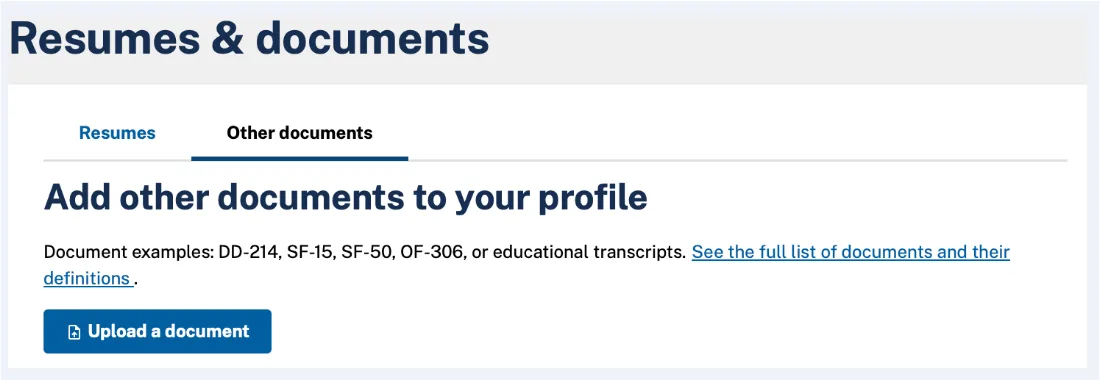
Pre-load everything: upload every document that applies to you to your USAJOBS profile now. Then you can submit the moment a position opens.
A contractor resume is not a federal resume
People who work both sides trip here, because the advice flips. Federal job vs contractor compares the two careers themselves.
A contractor resume is a normal private sector resume. Two to three pages. No hours per week, no resume builder. Certs stay short on the federal side. Here they carry real weight: PMP, CISSP, cloud certs, and the DoD 8570/8140 Security+, listed as held or in progress. Clearance status goes at the top. No clearance yet? Write "eligible" or "willing to obtain," then read how clearance sponsorship actually works next.
The biggest split is how broad you go. On the federal side, broad titles and general roles help you. On the contract side, drop the broad wording. Contracts spell out hard rules, like "three years of experience as a SharePoint admin." Your resume has to show exactly that, in the posting's words. Clearance plus cert plus experience usually settles it there, because those three are written into the contract itself.
Where to go from here
Everything above is the resume. Build the resume once with prompt 1. Then tailor one entry with prompt 2 each time you apply. That is the whole job.
Federal Resume FAQ
How long should a federal resume be?
Should I upload my own resume file or use the USAJOBS resume builder?
What does a federal resume need that a normal resume doesn't?
Can I use ChatGPT or another AI to write my federal resume?
Do I tailor my resume for every job I apply to?
Is a contractor resume the same as a federal resume?
The Resume Is Fixable.
So Is the Rest of It.
I coach people through this one-on-one for 16 weeks, and I take people who start from zero. Answer 7 quick questions to see if it fits where you are. It takes about 60 seconds.
See If You Qualify → Career coaching program · 7 quick questions · Free to apply