
Jobs That Sponsor a Security Clearance
Every posting says "active clearance required," and you can't find one company that sponsors. They are out there. They just word their postings differently. Here are the jobs that put you in for a clearance, and how to find each one.
You finished school. You have internships on your resume. You search for cleared jobs, and every posting says the same thing: active TS/SCI required. Even the guard jobs at the gate, the ones people call the easy way in, want a clearance you don't have yet. So where are the companies that sponsor?
There are thousands of them. They just word their postings in a way most people skim past. And they sit in a few kinds of work that are easy to find once you know where to look. This page lists the jobs that sponsor a security clearance, what each one asks of a beginner, and the searches that turn them up.
The short answer
The jobs that sponsor a security clearance fall into five groups. Federal jobs that need a clearance. The spy agencies, which put nearly everyone they hire in for one. Defense company jobs posted with the words "ability to obtain." Internships and starter programs at agencies and big firms. And background check jobs. Most of the work is in IT, cyber, engineering, supply, and office support.
How sponsorship works is its own topic. You can't apply for a clearance yourself, so an employer puts you in for one when it hires you into a job that needs it. The full method is in how to get a security clearance. This page is about which jobs to aim at.
Here are the five groups, and what each one asks of you. Pick two and work them at the same time.
Which government jobs sponsor a security clearance?
Almost every federal job that needs a clearance will sponsor you, even when the posting doesn't say so. The agency is the sponsor. You apply like anyone else. If the job needs a Secret or a Top Secret, the agency puts you in for it after the offer.
The biggest pool is the Department of Defense, which has more civilian staff than any other part of the government. They work as engineers, IT staff, analysts, project leads, supply managers, and office staff. Many of those jobs need a clearance. Homeland Security is another big one, with jobs in cyber, disaster response, and law enforcement.
To find them, build your resume in the USAJOBS resume builder. Then click Search with no filters filled in. In the Filters panel, open Security Clearance and check Secret, Top Secret, and Sensitive Compartmented Information. Set Who Can Apply to Open to the Public. Then add any hiring path that fits you, such as Student or Veteran.
Most federal jobs don't need a degree. Work that fits the job counts, and it often counts for more. New grads tend to start at GS-5, GS-7, or GS-9. GS is the General Schedule, the government's main pay scale, and those are its first rungs. If you have work history but nothing federal, read how to get a federal job with no experience before you apply.
The spy agencies hire people who aren't cleared yet
Nearly every job in the Intelligence Community comes with sponsorship. The Intelligence Community, or IC, is the 18 federal agencies that gather and study intel. Get hired there and you get put in for a clearance. In the IC, that means a Top Secret with SCI. SCI is a tightly held layer that sits on top of Top Secret.
Start at cia.gov/careers and intelligencecareers.gov. Then do the same at NSA, DIA, NGA, NRO, and the FBI. Check the minimum rules first, because many IC jobs list school rules. Then take your time and send a full, careful application.
IC hiring takes the longest of any group on this page, and the polygraph is common. Some agencies add it to the clearance. Read what the polygraph is like before you start. Then apply, and work a faster group from this page while you wait.
Which companies sponsor security clearances?
Defense contractors do, and the ones that sponsor say so with three words: "ability to obtain." A contractor is a private company paid to do work for an agency. Most of their postings ask for an active clearance, because a cleared hire can bill the government on day one. The postings with those three words are the ones written for you.
Start with the five companies I send everyone to: GDIT, Leidos, Booz Allen Hamilton, Lockheed Martin, and ManTech. Search each careers site for "ability to obtain." Then widen the list. CACI, Peraton, SAIC, Northrop Grumman, and RTX all hire for cleared work at scale. KBR and Amentum hire for supply, building, and jobs overseas.
Two searches find the rest. On ClearanceJobs, the biggest cleared job board in the country, search the exact phrase "ability to obtain." You can use it without a clearance. It's the best way to find small firms you've never heard of. On Google, search site:careers "ability to obtain" "security clearance" jobs and work through the companies it turns up.
The contractor jobs that sponsor, by type
Contractor jobs are narrow. Pick the type that fits your past work or the cert you're working on. A cert is a certification, a test-based credential that proves a skill. Then search for that job title plus "ability to obtain."
IT help desk and desktop support. This is the front door. Help desk techs reset passwords, get locked-out users back in, and fix basic computer problems. Agencies staff help desks in large numbers and hire junior people to do it, so there are always openings. No degree is needed. Search for Help Desk Analyst, IT Support Specialist, and Desktop Support Technician.
Systems and network administration. This is the step up from help desk. Admins keep servers and networks running. Jobs on Defense and other secure networks often need a Secret or Top Secret. A degree isn't needed here either. Security+ plus a network cert like the Cisco CCNA is the usual pair.
Cybersecurity. Cyber analysts and network defenders watch an agency's networks for attacks and fix the holes. Most federal cyber work needs a clearance, often Secret or higher. Firms ask for Security+ and often a second cert like CEH, the Certified Ethical Hacker. The interviews are technical, so expect to show what you know.
Software and engineering. Coders sit on the IT side. Engineers design and keep up the government's systems, bases, and buildings. These jobs almost always want an engineering degree. They come with a clearance when the project is classified.
Program and office support. Assistants, HR staff, budget analysts, and project coordinators keep a contract running. These jobs want past work in the field and strong computer skills. Some of them come with a clearance, so read the clearance line on every posting.
Supply, repair, and the trades. Supply techs, warehouse staff, aircraft and truck mechanics, electricians, and HVAC techs. Much of this work sits on military bases, at home and overseas. Clearances aren't only for spies and IT. Housekeeping, teaching, transport, and health jobs can carry one too.
Linguists and intel analysts. These jobs sit closest to the spy work itself. Firms hire analysts, linguists, and HUMINT collectors, mostly to back up military and IC work overseas. HUMINT means human intel, which is what you learn from people.
Guards and gate staff. Security staff guard the sites where classified work happens and check who gets in. Many of these postings ask for an active clearance. Apply to the ones that say "ability to obtain" and skip the rest.
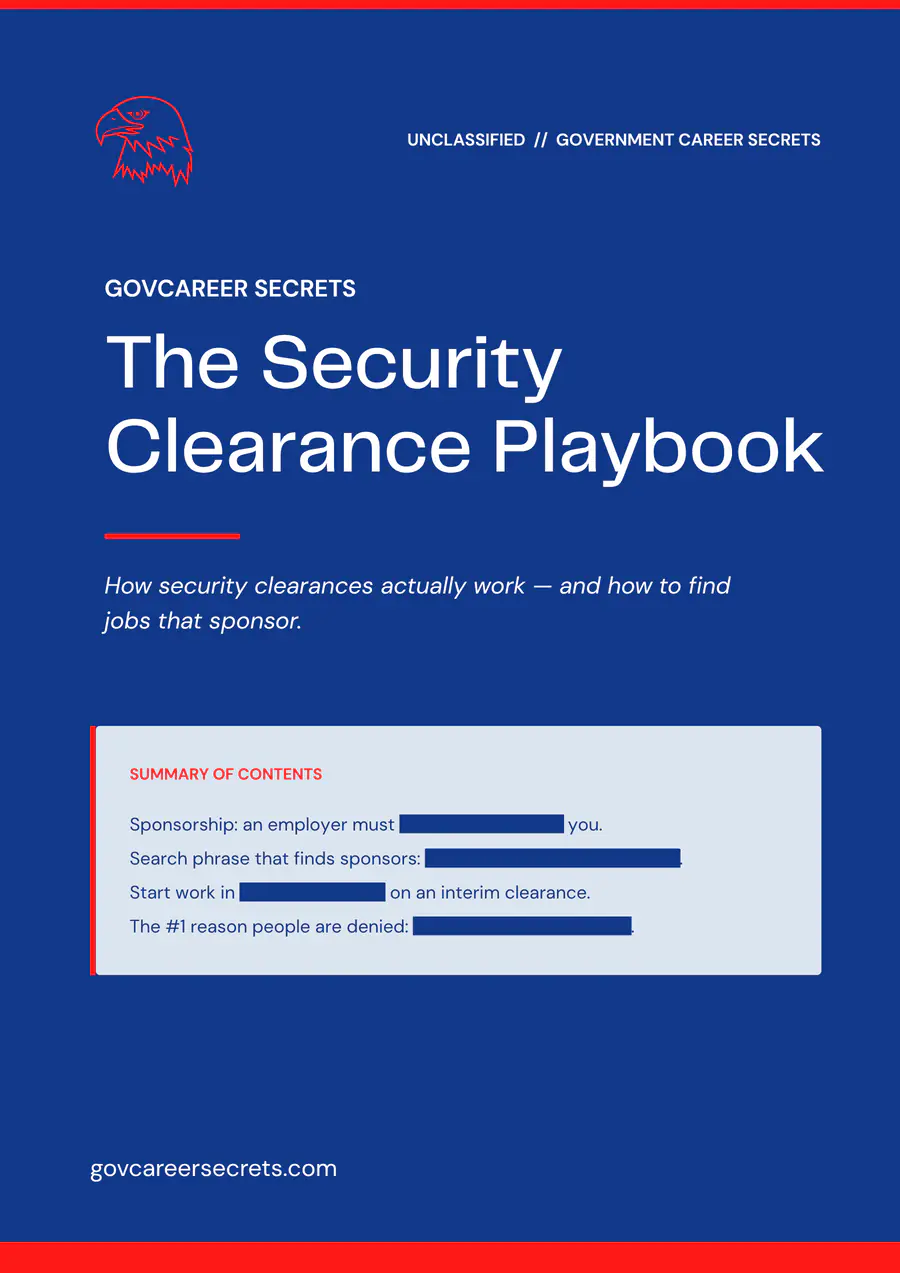
The Security Clearance Playbook, Free
✓Four proven ways to get sponsored, down to the message to send a recruiter
✓The ten myths that keep people out, and what really disqualifies you
✓What happens once you're sponsored: the SF-86, foreign ties, and the polygraph
Where should we send it? It's free.
Internships and early-career programs that sponsor
If you're a student or a new grad, start here. Big contractors such as Booz Allen, CACI, and Peraton run internships and starter programs that often lead to full-time offers. Many of them have clearance sponsorship built in. They hire you, and they put you in for a clearance as part of the deal.
On the federal side, the Pathways program has two doors. The Internship program is for students enrolled at least half-time. Recent Graduates is for anyone within 2 years of finishing a degree or certificate, or 6 years for veterans. Internships can turn into full jobs after you graduate. The pool is small next to Open to the Public, so your odds are far better.
Most IC agencies also run student programs in the fields they hire for most. You'll find them on intelligencecareers.gov, agency by agency.
Then go where the recruiters are. ClearanceJobs runs about 20 cleared hiring events a year, and contractors send recruiters to them. A computer science degree with internships is just what these programs are built for. If the active-clearance postings keep turning you down, move that time here.
Background investigator jobs
Background investigators run the checks behind a clearance. They talk to the person being cleared and the people that person listed. They check records and write up what they find for whoever makes the call. The job itself needs a clearance, usually a Secret and often a Top Secret. Many of these jobs are entry level, with training on the job.
You need to be able to get a clearance and pass the training. Most postings ask for a bachelor's degree or 3 to 5 years of police or federal work. CACI and KeyPoint hire the most, along with other firms that hold contracts with DCSA, the Defense agency that runs most clearance checks. Search CACI's careers site for "investigator" to see what the postings ask for.
Security clearance jobs with no degree and no experience
They exist, and help desk is the easiest door. It's broad, it's always hiring, and it asks for good people skills and basic computer know-how. In contracting, a degree is useful, but mostly it lowers the years of work a posting asks for. A posting might ask for 12 years of combined work and school, with a bachelor's degree counting for about 4 of them.
The fastest way to stand out with no work history is Security+. It's a beginner cert from CompTIA that shows you know the basics of keeping networks and data safe. Defense contracts require it as a baseline for many IT jobs. You need no past work to take it, and most people are ready in 3 months or less of study. List it on your resume as obtained or in progress.
Then put this line at the top of your resume: U.S. citizen, eligible to obtain a security clearance. It's the first thing cleared recruiters search for. The rest of that resume is in how to put a security clearance on your resume.
Be open about where you'll work. Many of these jobs sit on bases or at agency offices around Washington, DC, in Huntsville, Alabama, and in other defense hubs. I moved across the country for mine. And if a job sponsors but pays less than you hoped, take it unless you have something better. Once you're cleared, things move fast.
Aim for a job that sponsors a Top Secret
The level of your clearance comes from the job, not from you. So aim at the jobs that sponsor the level you want, and want the top one. TS/SCI is the most valuable clearance there is. It opens IC careers and the best-paid cleared work. It makes you the one every cleared recruiter is hunting for.
For IT and cyber, the formula I teach has four parts: Security+, one more cert in your field, a TS/SCI, and one year of related work. That mix checks every box a contractor screens for. You build most of it at the same time, and it comes together in about a year.
A clearance can also move up. Secret can be raised to Top Secret, and Top Secret to TS/SCI. Some firms let you work at the lower level while the higher one is in process. The full comparison is in Secret vs Top Secret.
Where to go from here
Pick two of these groups and work them at the same time. The people who get sponsored fastest are the ones with the most applications out. My free playbook turns that into a weekly plan: 20 applications and 20 recruiter messages, plus the exact message to send.
Jobs That Sponsor FAQ
What entry level jobs sponsor a security clearance?
Can I get a security clearance job with no degree?
What jobs sponsor a Top Secret clearance?
Am I too old to get a security clearance?
How do I find jobs that will sponsor a clearance?
Now You Know Who Sponsors.
Let's Get You Into One.
I coach people through this one-on-one for 16 weeks, and I take people who start from zero. Answer 7 quick questions to see if it fits where you are. It takes about 60 seconds.
See If You Qualify → Career coaching program · 7 quick questions · Free to apply