
How to Put a Security Clearance on Your Resume
The exact line to write, where on the page it goes, and what to leave off. All of it built around the way a cleared recruiter actually searches.
Your clearance is the most valuable line on your resume. It is also the line most people get wrong. The usual advice is to drop it under Skills and move on, and that advice comes from people who have never filled a cleared job.
Here is how the cleared side of the market actually reads it.
The short answer
Put your clearance at the top of page one, on its own line, in four pieces. The word Active, your level, the agency that held it, and your polygraph if you have one. That reads Active Top Secret/SCI security clearance | DoD, CI polygraph. List it a second time in the job entry where you held it.
Level and polygraph are the two fields a cleared recruiter filters on before anything else, so the line has one job. Get you found. The rest of your resume gets read second.
How cleared recruiters actually search
ClearanceJobs is the biggest cleared job board in the country. On the employer side, it is not a stack of resumes. It is a search box.
A recruiter narrows the pool by clearance level and polygraph first. Then by state, resume age, job category, degree, and whether you will move. Then they run a keyword search, or paste in the job description and let the site rank people against it.
That one fact shapes everything you write. Level and polygraph are not things a recruiter forms an opinion about. They are checkboxes. You are inside the results or you are not there at all. The rest of your resume gets read second.
So your clearance line has one job. Get you found.
Where the line goes
The top of page one. Put it in the header block, on its own line, above or beside your summary, before the first job. That is where a cleared recruiter's eye already goes. Buried under Skills, tucked inside a bullet, or sitting at the bottom under "Additional Information" is too late.
The job where you held it. List it a second time in that job entry. The dates on that job tell a recruiter when your access ended, and that date is what sets how fast you can be picked back up.
USAJOBS, a different kind of resume. A federal resume is built to strict rules: see how a federal resume has to be formatted. The clearance line still goes at the top, but almost everything around it changes. A contractor resume is a normal private-sector document, and it rewards packing in certifications and the exact words from the posting. Federal job vs contractor weighs the two paths.
How to word the line
Four pieces, in this order, on one line.
- The word active. Write Active. The next section is about why.
- Your level. Secret, Top Secret, or Top Secret/SCI. Write the level you were granted, not the level of the work going on around you.
- The agency that held it. DoD, DIA, NSA, DOE. Write it the way postings write it.
- Your polygraph, if you have one. CI or full scope. It is worth its own words in cleared hiring.
Put together, that reads: Active Top Secret/SCI security clearance | DoD, CI polygraph.
Change the level to yours and you have your line. It fits on one row, and a recruiter can read it in about a second. No dates, and nothing about your current situation.
Interim clearances. An interim lets you start work while the investigation finishes. Write Interim Secret and leave it there. A cleared recruiter knows what that means, and an interim is a hireable status on its own. How long a clearance takes covers how interims work.
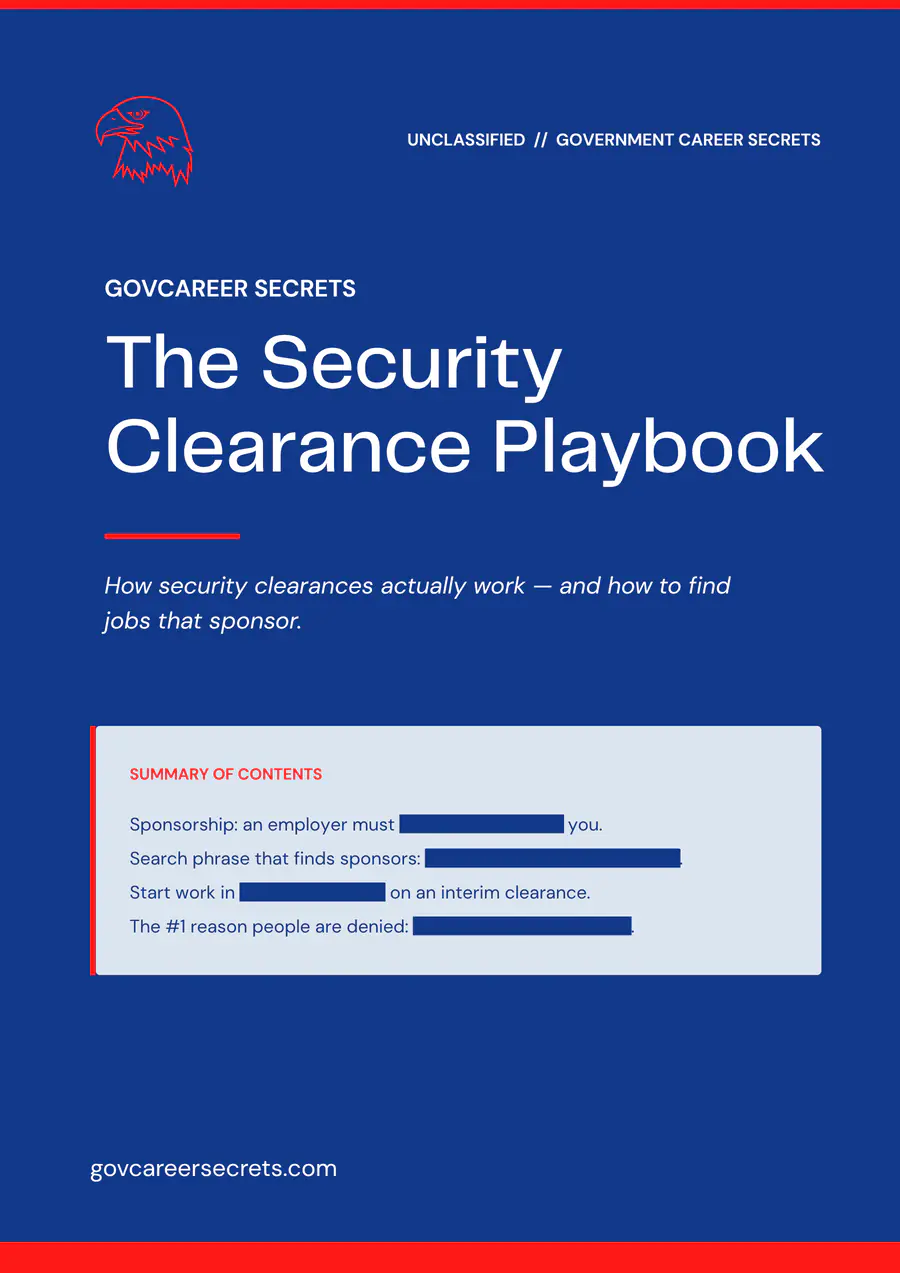
The Security Clearance Playbook, Free
✓Four proven ways to get sponsored, down to the message to send a recruiter
✓The ten myths that keep people out, and what really disqualifies you
✓What happens once you're sponsored: the SF-86, foreign ties, and the polygraph
Where should we send it? It's free.
Why "active" is the word to use
Most people reading this are between cleared jobs. The contract ended, the layoff came, or you separated from the military. Your access stopped when the job did. The clearance itself sits there for about two more years, ready for the next employer to pick up. Is my security clearance still active walks through that window.
Insiders split hairs over the words. Active means you are in a cleared seat today. Current means you are between jobs and still good to go. Recruiters don't sort candidates that finely, and neither do the search tools.
Active is what gets searched. Postings ask for it. Recruiters type it. Filters run on it. So put Active Top Secret security clearance near the top of page one, at whatever level you hold, and you land in the pile the recruiter is looking at.
Inactive is the word that costs you. To a cleared recruiter, inactive reads as expired. It says new investigation, new timeline, months of waiting. Put that word on a clearance you used nine months ago and you have handed people a reason to scroll past you.
The form field on the boards. Registering on a cleared board means picking active or expired from a menu. Pick active. Then put the same line in your headline, your summary, and the resume file you upload, because those three are what the search reads.
What to leave off
Your level and your status are not classified. Plenty of what sat behind them is. None of it helps you land the interview, so there is no reason to spend a line on any of it.
- SCI compartment names and codewords.
- Special Access Program names.
- The specific systems and tools from the classified work.
- Site names where the site itself is sensitive.
- Project names and operational detail.
The stacking problem. A job title, a clearance level, a customer site, and a program name are each dull on their own. Stacked on one public profile they draw a picture. Scammers and foreign recruiters build target lists out of exactly that mix.
The unclassified version of the work. Function, size, result, no program name. "Administered a 4,000-node enclave for a DoD customer and cut patch latency 60%" shows the size of the job without naming the program. Where the customer itself is sensitive, "a DoD customer" or "an Intelligence Community customer" is the standard phrasing, and nobody reads it as dodging.
Your security officer. They read resume wording all the time, and their answer is the one that counts. It is a five-minute conversation and it costs nothing.
Your ClearanceJobs profile is what recruiters search
You need a clearance to register there, which is why more cleared recruiters search there than on a general job board. Once you are in, the profile is the thing that gets searched. Build it for that.
- The headline. Loaded with the words a recruiter would type: TS/SCI-Cleared Cybersecurity Analyst | 10+ Years DoD. Not a bare job title.
- The keywords. Language from real postings, worked into your summary, skills, and experience. The match search compares a job description against your text, so shared words are the whole mechanism.
- The uploaded resume. Word or PDF, led by accomplishments instead of duties. This file is what the keyword search reads.
- Certifications. Security+, CISSP, CCNA, cloud certs, PMP. On the contractor side these are often hard contract requirements. A cert plus a clearance plus the right experience answers most cleared job postings on its own.
- Recency. Resume age is one of the filters a recruiter can set. A profile you have not touched in a year falls out of those searches. A small edit each month keeps you in.
- Visibility settings. These decide whether recruiters can contact you at all. Worth a look rather than a guess.
LinkedIn, at the right volume
LinkedIn is where recruiters who are not on a cleared board find you. It is also the most public page you have, so the same split applies here as everywhere else on this page. Your status can go up. The details of the work cannot.
What goes there. Your level and status, in the headline or the About section, in the same plain words your resume uses. That is what makes you findable, and what tells a recruiter you can start soon.
What stays off. Program names, compartments, contract sites, customer names, systems. Write that page as though a stranger building a target list is reading it, because one might be.
If you are not cleared yet
Nobody gets a clearance on their own. An employer sponsors you. Postings that will sponsor say so with a specific phrase: "ability to obtain." Your half of that sentence is "eligible to obtain." The jobs that post those words, by type, are in jobs that sponsor a security clearance.
It goes in the same slot at the top of page one: U.S. citizen, eligible to obtain a security clearance. It is the first thing a recruiter filling a job that will sponsor you looks for, and it is missing from almost every resume they get. How clearance sponsorship actually works covers the four routes in.
Where to go from here
Wording the line is the easy part. The bigger job is getting in front of the recruiters who pay for it, and asking for the cleared pay bump when they call. The playbook covers what a clearance is worth, who hires for it, and the message that gets a recruiter to reply. Not cleared yet? The four routes to sponsorship are in there too.
Clearance on a Resume FAQ
Where on a resume does a security clearance go?
How do you list a clearance that is no longer active?
Can you list your SCI compartments or the programs you worked on?
Is a ClearanceJobs profile worth building if you already have a resume?
Should your security clearance be on LinkedIn?
The Clearance Line Is Easy.
Aiming It Is the Hard Part.
I coach people through this one-on-one for 16 weeks, and I take people who start from zero. Answer 7 quick questions to see if it fits where you are. It takes about 60 seconds.
See If You Qualify → Career coaching program · 7 quick questions · Free to apply